RatingTimeMode

Chinese chess for chess players, and original strategy games. Free and open source. About Mistboard...

News

More »

Wanted: a neural network for Jieqi.

Our Jieqi bot is a hand-written classical engine, and a strong player beats it. Pikafish's jieqi branch has the search and a jieqi NNUE architecture but has never had weights to load; we trained ten nets on the classical engine's own evaluations and none beat it. If yours does over a 200-game match, it becomes the bot on this site, with your name on it. Banqi and Jungle are open on the same terms, and there is a best-of-eight against the Jieqi bot for players.
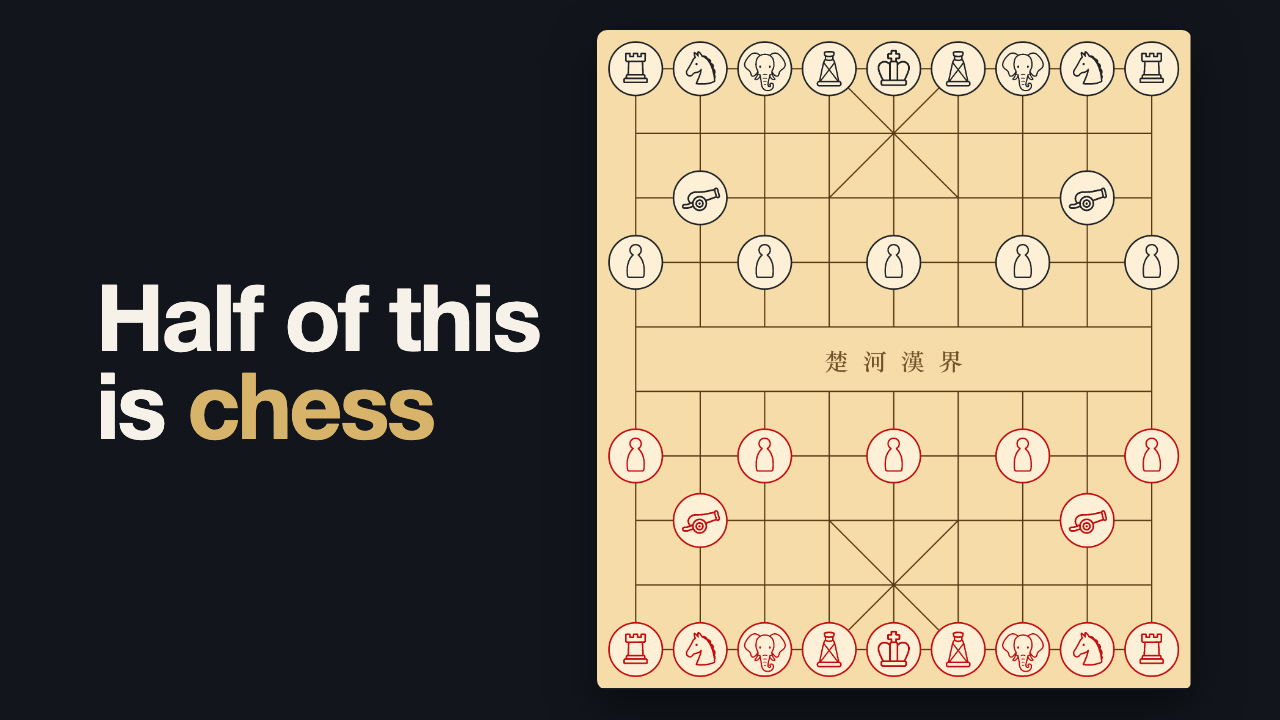
The Jieqi bot no longer knows which of your captures took its hidden pieces.

Jieqi reveals a captured face-down piece to the capturer only. The bot was being told its own remaining hidden pieces from the true state, so every time you took one of its dark pieces it learned what it had lost and revalued the rest. It now reasons from what a player in its seat may know. Its opponents' captured pieces stay known to it, as the rule allows.

Atomic Xiangqi has launched.

Chinese chess where every capture is an explosion: the piece that captures, the piece it takes and everything on the four points beside it are removed. Soldiers survive a blast; a general does not, so a capture next to the enemy general wins on the spot and you can never capture next to your own. The cannon is the one exception, its shot takes only its target. A threat to blow up the general counts as check for the repetition rule. Same set, same array, eight bot levels or a friend.

Two of the four great Qing composition manuals are online.

Fragments of a Martial Mind (1800) and Deep Abyss, Wide Sea (1808) join the Elegant Pastime Manual: four hundred and seventy problems, each on its own board, with the book's line played out as the mainline and the original four-character title kept beside the English one. Positions come from dpxq.com and are credited on every composition. A problem whose recorded line does not survive replay, or whose diagram the engine reads differently from the book, is held back rather than published wrong. The other manuals on the same shelf follow over the coming weeks.

Puzzles with more than one solution.

A solver found a real checkmate and the site told them to try again. The puzzle had two answers, and the grader knew one. Mate puzzles now follow the rule lichess settled on: every move of the solution must be the only mating move, except the last, where any mate counts. The 382 served puzzles that failed it are withdrawn, and the article walks through the position that started it.

The statistics count visitor games only.

The games-played number on the home page and the statistics page now counts finished games between visitors, or a visitor and a bot, since the site opened in June. Engine matches, our own test games, and the games we played before anyone else had found the site are left out. That takes the number down to about a third of what it showed; the other two thirds was us.

Duck Xiangqi has launched.

Chinese chess with one duck that both players share. Make your move, then put the duck on any empty point. It blocks a horse's leg, an elephant's eye and the file between the generals, and it works as a cannon screen for whoever moves next, so the screen you build is never yours. There is no check: you win by capturing the general outright, and the two generals may now face each other down an open file, where flying the general is a capture. Play the eight-level bot or a friend.

All six volumes of the Elegant Pastime Manual are online.

The Elegant Pastime Manual is a Ming collection of xiangqi endgame compositions. Five hundred and forty-nine of its problems are here now, each on its own board, with the book's solution played out as the mainline and the original four-character title kept beside the English one. Around sixty are draw studies where the source gives its answer in prose rather than as a line, and those notes are quoted as written rather than guessed at. Positions come from dpxq.com and are credited on every composition. One problem is absent: the line recorded for number 479 stops being legal partway through, and half a solution is worse than none.

Patron checkout is open.

The Support page takes monthly subscriptions now, at $5, $10, $20, or $50. A subscription puts a heart badge on your profile and does nothing else: no Patron-only content, no gameplay advantage. Core play and learning stay free and are meant to. Subscriptions pay for the servers and the development time. Cancel from the billing portal at any point and the period you already paid for runs out.

Practice the basic endgames against the engine.

Thirty-two positions from the book endgames, each with a goal instead of a stored answer. The engine plays the defense and grades you on whether the win is still there after your move. A chariot cannot break the full defense and three soldiers can, which is the sort of claim you only believe after failing to prove it. Endgames come first because their verdicts are the part of xiangqi an English speaker has the least access to. More sets will follow.

Misty is open source.

The Fog of War chess engine you play here is on GitHub under the GPL, and installs from PyPI as misty-chess. It is a build of the architecture behind Obscuro, the first superhuman Fog of War chess AI, whose own code was never released. The engine article now says how it works, what version 1.6 fixed, and what is still wrong with it.

What strong jieqi players believe about the opening.

Jieqi has no opening book. What it has is an argument, running on Chinese forums for years among players with thousands of games, that has never appeared in English. Five first moves ranked, why a face-down piece is a one-shot option you can waste, and the pawn push weighed against the crossed cannon on all six things you might reveal. Our own fifty games disagree with the ranking, and the engine declines the list altogether.

More »

Latest studies

More »
Loading studies.